“The Sapphic Text: Queer Poetics in the Archive.”
Butch-Femme Press
Traditionally, women could only be categorised in two distinct ways—as angels or as monsters.
Mary Ryan, 2010.
One of the first archival visits I organised after beginning my PhD journey was to the Linen Hall Library in Belfast. Already captivated by the poetic work of Sappho, I came across a 1991 edition of Women’s News Magazine that featured a cartoon titled Sappho Woman by an unknown designer who goes by the initials 'GMK'. The magazine also included a section at the back of each issue called ‘Women’s Words’ dedicated to poetry. This discovery led me to Marie Mulholland, who, as a member of the Women’s News Collective in the 1980s, teamed up with two other collective members to form Maeve Publishing. Together, they produced Northern Ireland’s first-ever lesbian cartoon book, Sappho Woman. Historically, as Mary Ryan writes, the ‘ideal’ woman would be one who was passive and allowed themselves to be objectified by men. Any woman who dared to push back against this was regarded as a “monster” and “had to be punished for refusing to conform to societal expectations” (2010, p. 93). Since Classical Rome, European literature has consistently included portrayals of a certain group of women, identified by various terms such as “Sapphists, tribades, tommies, and lesbians” (O’Donnell, 2003, p. 1). These women were sometimes depicted as having unnatural, monstrous desires for same-sex relationships and often characterised by an intense ‘demonic love’ and attachment to other women. This imagery appears across genres from poetry to journalism, where these so-called "freakish" women were frequently depicted (ibid.). O’Donnell further explains:
It had been different in the age of Classical Greece when the poetry of Sappho from Lesbos, described as the tenth muse, took erotic love between women as her main theme and dwelt on the many passions this love inspires. Her poetry was admired for centuries, and the love was not regarded as perverted or deviant but as Christianity became widespread throughout Europe there was a systematic purge of these Sapphic texts, helped greatly by the accidental burning of the library at Alexandria. (ibid., p. 2)
Sappho, “The Poetess” (Mendelsohn, 2015), was a musician and lyric poet who resided in the Greek island of Lesbos in approximately 600 BCE. It is believed that the term ‘lesbian’ derived from this island. Celebrated as a genius of her time, Plato hailed her as “the tenth Muse” (Poetry Foundation, 2019). Her work is vulnerable and tender, speaking earnestly and declaring her love for other women. Many scholars have tried to diminish her queerness, changing the narrative of her work to make her seem ‘heterosexual’. However, to strip Sappho of her queerness is to ignore her work entirely. These controversies surrounding her personal life have taken up much space in sapphic studies. As Anne Carson states, “it seems that she knew and loved women as deeply as she did music. Can we leave the matter there?” (Carson, 2002, x).
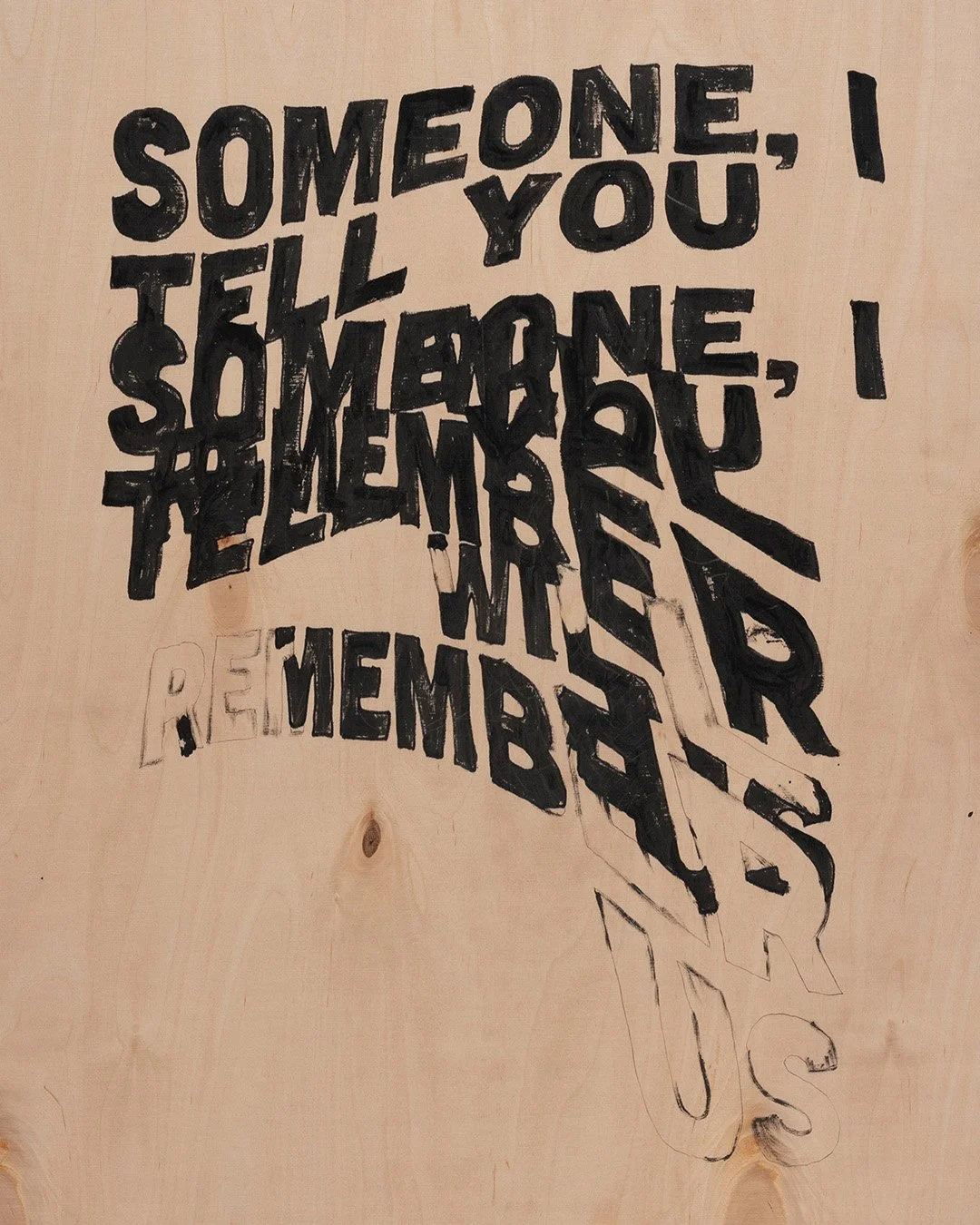
Today, only remnants remain of Sappho’s poetry. During Christianity’s peak political influence, leaders sought to destroy as much of her writing as they could (Mills, 2016). In 391 BCE, nine volumes of her poetry were held in the Alexandrian library, which was destroyed by fire. Since then, preserving her work has been difficult and often resulted in fragmentary versions, with most of her work formed by quotes and other writings. Many writers today attempt to revisit her work, creating new meanings and translations (see Rayor, 2023; Schwartz, 2022; Carson, 2003; Barnard, 1958). Various readers and scholars have viewed Sappho as a lesbian role model or feminist heroine—most often, both. Sappho’s partial fragments offer a glimpse into her deep desire to be remembered. One of the earliest works created for Living but a Day was directly inspired by her line “Someone, I tell you, will remember us, even in another time” (Fig. 1), which appears overlapped and distorted. Although her poetry endures through fragments, Sappho, just as she predicted, is remembered.
Title: “The Sapphic Text: Queer Poetics in the Archive”
Author(s): Austin, Chloe.
Citation: Austin, Chloe. “The Sapphic Text: Queer Poetics in the Archive.” Butch-Femme Press
Literary Journal, edited by Anaya Patel, Vol. 2, Winter 2026.